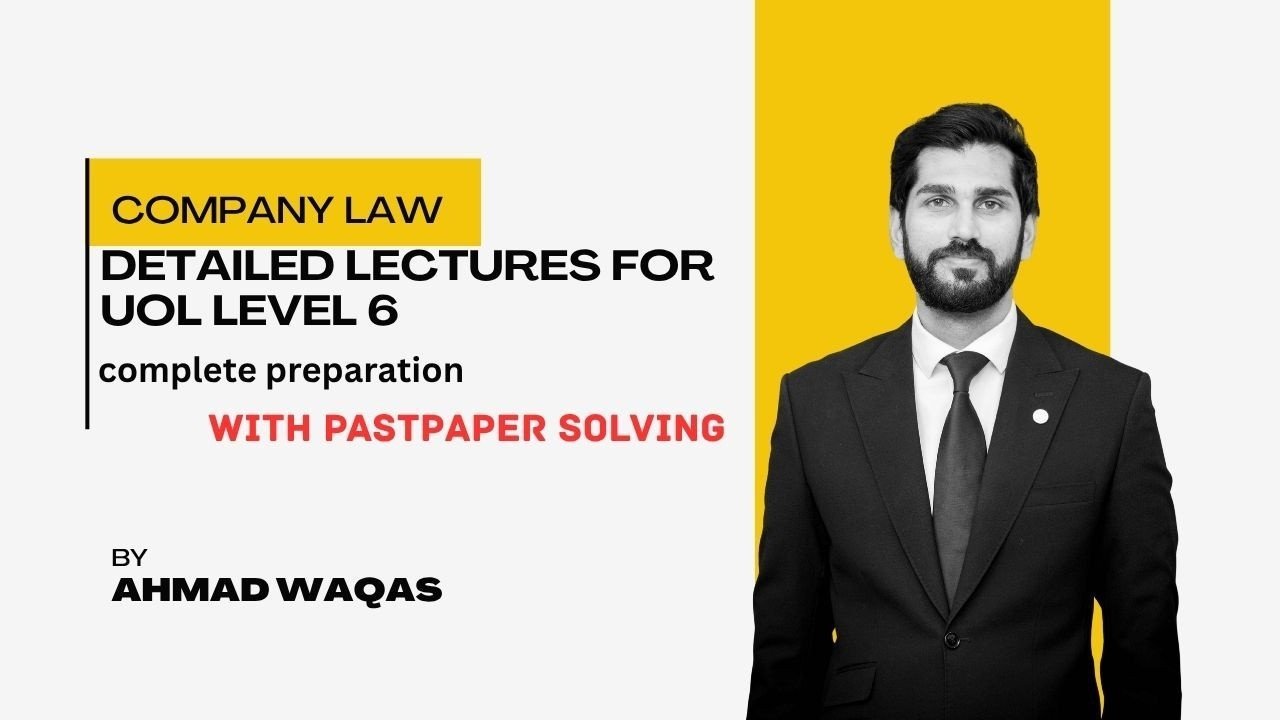
Companies run much of modern economic life, from small family businesses to multinational corporations. This module explains how a company comes into existence as a separate legal person, who controls it, and how the law protects shareholders, creditors and others who deal with it. You will study:
- Corporate personality:incorporation, the principle in Salomon v Salomon, and when courts will pierce the corporate veil, as discussed in Prest v Petrodel.
- The company’s constitution:the articles of association, their contractual effect under s 33 of the Companies Act 2006, and how they can be altered.
- Dealing with outsiders:corporate capacity, the authority of directors and agents, and pre-incorporation contracts.
- Share capital:issuing shares, the rules on capital maintenance, and distributions to shareholders.
- Directors:appointment and removal, and the statutory duties in ss 171 to 177, including the duty to promote the success of the company and to avoid conflicts of interest.
- Shareholder protection:majority rule, derivative claims, unfair prejudice petitions under s 994, and just and equitable winding up.
- Corporate governance and insolvency:governance codes and accountability, and the liability of directors for wrongful and fraudulent trading.
These lectures follow the University of London module guide. We work through the Companies Act 2006 alongside the leading cases, showing how the law balances commercial freedom against accountability. You will learn to analyse corporate problem questions systematically and to write critical essays on the purposes of company law, as the UoL examination requires.
|
Company Law — Student Handbook (Included with every module)
Each module comes with a comprehensive digital handbook covering:
✔ Complete Lecture Notes — detailed notes covering all topics in this module
✔ Topical Past Papers — curated past paper questions organised by topic
✔ Question Structures — step-by-step frameworks for essays and problem questions
✔ Solved Model Answers — first-class standard answers to exam questions
|